
24-hour
storm damage
TREE service

If a tree just came down on your property, here’s the short version: call us at (416) 997-7280. We run a 24-hour emergency response across the Greater Toronto Area, including nights, weekends, and holidays, and we can walk you through what to do while you wait for us to arrive.
Call now
& get a quote
What to Do After Serious Storm Damage
Stay away from the tree and anything it’s touching, especially if it’s anywhere near a power line. Treat any downed line as live, even if it looks dead, and call your utility provider in addition to us. Keep kids and pets out of the area, and if the tree is resting against your house, avoid the rooms directly underneath it until we’ve assessed the structure. Beyond that, the safest thing you can do is wait for our team rather than trying to clear anything yourself.
If it’s safe to do so from a distance, photos of the damage before cleanup begins can help if you’re planning to file an insurance claim later. We’ll always document the damage on our end too.
Why Storm Damage Isn’t Always What It Looks Like
After a storm, the worst damage is rarely the branch lying across your lawn. It’s the one still hanging twenty feet up, or the root system that shifted underground without a single visible sign above it.
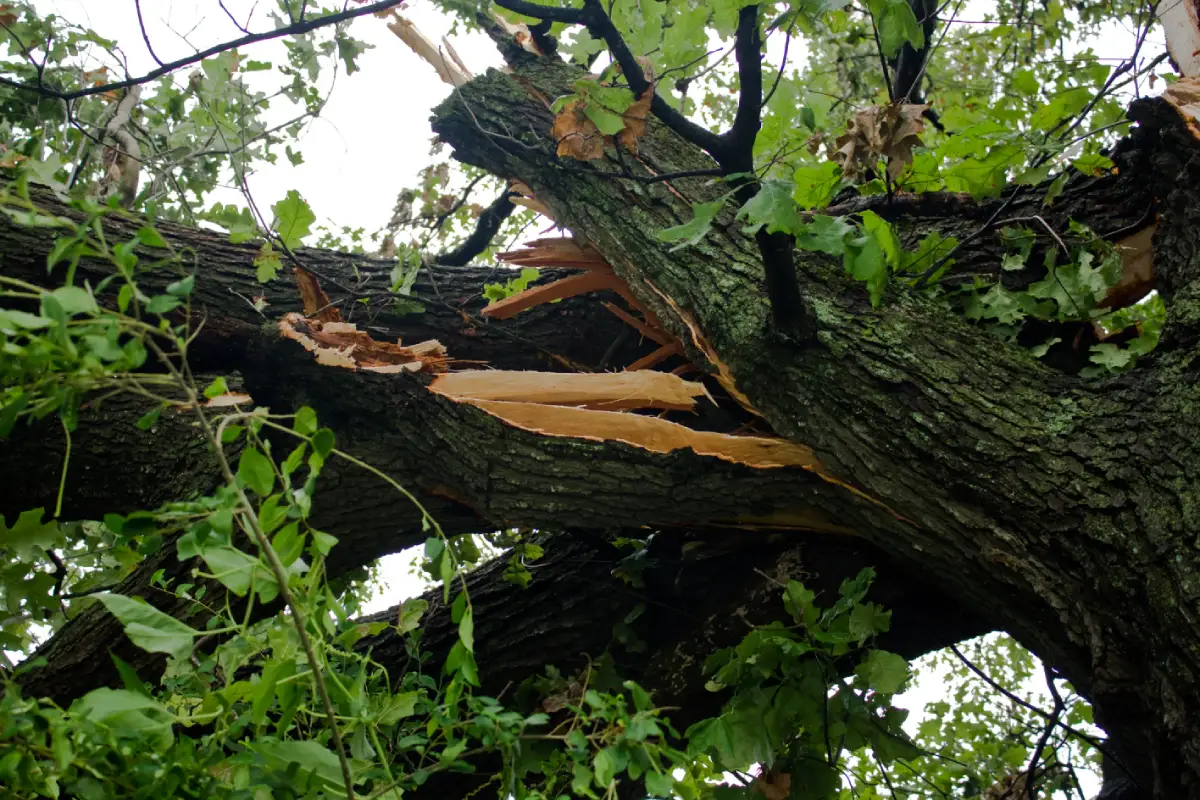
Storm damage doesn’t only affect what you can see. It can crack branch unions, shift a tree’s root system underground, and weaken the wood inside the trunk without leaving obvious damage on the bark. A branch that’s fully broken loose but still resting in the canopy, sometimes called a widow-maker, can look almost identical to a healthy one from the ground. The difference is that it’s held up by tension or a strip of bark instead of sound wood, it can come down without warning.
This is exactly why a tree that “looks fine” after a storm sometimes comes down weeks later in nothing worse than a moderate wind. It’s also why we don’t recommend eyeballing storm damage from the ground or a ladder. Our team will check for the specific signs that indicate hidden risk, not just the obvious ones.
How We Decide What Gets Attention First
After a widespread storm, it’s common for a single property to have several damaged trees. We prioritize storm damage by risk, not by which tree looks worst.
Anything actively leaning toward a house, a driveway, or a path people use regularly comes first, since the consequence of failure there is highest. Trees showing signs of root movement come next, because that kind of damage can fail with little warning even when the canopy looks untouched. Hanging limbs over high-traffic areas rank close behind. A cracked branch over an unused corner of the yard can usually wait a few more days safely, which is also how we’re able to get to genuine emergencies quickly during a busy storm season.
Our Storm Damage
Services
Our emergency team responds to every type of storm damage, from fallen trees to dangerous hanging limbs and uprooted root systems. That includes removing fallen or damaged trees and branches, clearing debris from driveways and roads, and putting temporary protection in place, like a tarp over an exposed roof section, until permanent repairs can happen. We come equipped with chainsaws, chippers, and trucks built for this kind of work, and we know the local rules around emergency removals so nothing holds up the process.
A tree that looks stable after storm damage can still be holding tension that makes it dangerous to approach, and a branch caught on a power line is not a job for anyone without the right training. Our professional team have handled hazardous, high-pressure removals for over 12 years.
Can Your Storm-Damaged Tree
Be Saved?
Not every storm-damaged tree needs to come down, and we’d rather prune and monitor a tree than remove it unnecessarily. A single broken branch, even a large one, is often manageable with structural pruning that removes the damaged limb cleanly back to a healthy union.
Removal becomes the safer option once the damage reaches the tree’s main structure. That includes a split trunk, a significant lean tied to root movement, or decay that’s now exposed by a broken section and compromising more than about a third of the trunk’s cross-section. Species plays a role too. Silver maple and Manitoba maple, both common across the GTA, tend to handle storm damage worse than oak or hickory of a similar size, since they’re more prone to internal decay to begin with.
Whether your tree falls into the prune-and-monitor category or the removal category depends on the specific tree and what’s around it, which is exactly what we assess on-site rather than guessing over the phone.
What Happens
When You Call
Step 1
You Call
J&C Tree Services
Our 24-hour line is answered any time a storm has left a tree down or hanging.
Step 2
We Assess
the Risk
Our team arrives on-site to check the canopy, trunk, and root system for hazards, not just the obvious damage.
Step 3
We Secure
the Property
Safety comes first. We remove the immediate danger, whether that’s a hanging limb over a walkway or a leaning tree over your roof.
Step 4
We Clear
the Debris
Fallen trees, branches, and debris are removed from your driveway, roof, and yard so your property is safe again.
Step 5
We Handle Temporary Repairs
If your property needs short-term protection while you arrange permanent fixes, we can help with that too.Frequently Asked
Questions
How fast can you get here after a storm?
Response times depend on the extent of the storm and how many calls we’re handling at once, but our team is dispatched around the clock and prioritizes active hazards first
Will this help with my insurance claim?
We document the damage and the work performed, which most insurers ask for as part of a claim. Photos taken before cleanup, if you’re able to safely take them, are worth having as well.
What if the tree is on a shared property line or fell from a neighbour’s yard?
We can still assess and remove the tree regardless of where it originated. Property line and liability questions are worth raising with your insurer separately, but they won’t hold up the removal itself.
Can a storm-damaged tree be saved, or does it always need to come down?
It depends on where the damage is. A single broken limb is often fixable with pruning. Damage to the trunk, root system, or a large share of the tree’s structure usually means removal is the safer call.
Do I need a permit if my storm-damaged tree needs to be removed?
Depending on the tree’s size and your municipality, possibly. Toronto requires a permit for private trees 30 centimetres or more in diameter, though storm-damaged and hazardous trees are often handled on an expedited basis. We check this as part of our assessment and manage the permit process if one’s needed.
Should I remove a fallen tree myself?
No. Trees damaged by storms often contain bent limbs and branches under tension that can move unexpectedly when cut. If the tree is touching a structure or power line, stay clear and call a professional.
My tree didn't fall. Should it still be inspected?
Yes. Storm damage isn’t always obvious. Hidden cracks, damaged roots, or partially broken branches can leave a tree unstable long after the storm has passed.
Helpful Articles
From Our Blog


Not an Emergency?
We Also Handle Pruning, Removal, & Cabling
If your tree needs attention but isn’t an active hazard, our tree pruning and trimming and tree removal services cover the rest. If a tree survived this storm but you’re worried about the next one, tree cabling can add support to a structurally weak tree before it becomes an emergency.

Call for Immediate Storm Damage Assistance
A tree down on your property only gets more dangerous the longer it sits. Call our 24-hour line and we’ll get someone moving.