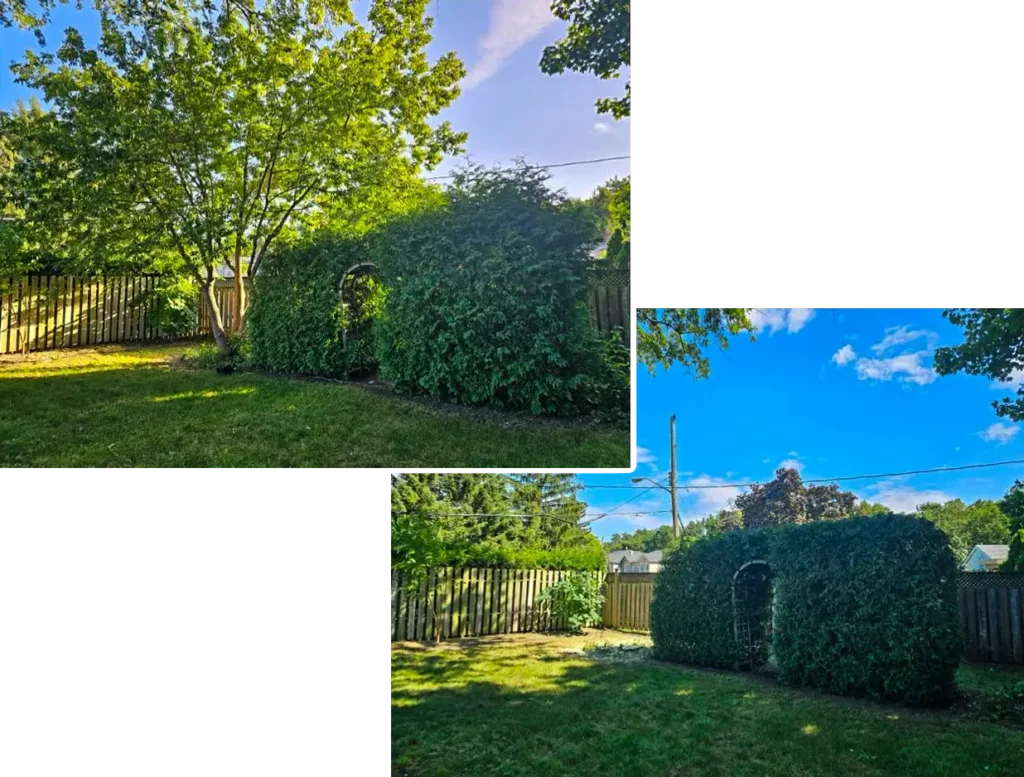
Hedge
Trimming


A hedge that has been left alone for one growing season too many can start working against the rest of your property, blocking a walkway, swallowing a fence line, or turning from a clean privacy screen into an overgrown wall of green. J&C Tree Services provides hedge trimming for homeowners and businesses across Toronto and the Greater Toronto Area, shaping and maintaining hedges so they stay healthy as well as tidy.
For over 12 years, our tree professionals have trimmed hedges of every size and species across the GTA, from foundation plantings that need a light seasonal shape up to overgrown cedar rows that have gotten away from a property for a few years running.
Call now
& get a quote
How Do You Know Your Hedge Needs Trimming?
Most hedges show a few warning signs before they get away from a homeowner entirely.
- Growth that has crept noticeably wider or taller than the season before, encroaching on a walkway, driveway, or the neighbouring yard
- Bare or thin patches near the base where light used to reach but no longer can
- Dead or broken branches showing through gaps in the outer foliage
- A shape that has gone soft or uneven since the hedge’s last proper trim
- Foliage that has browned or dropped inside the hedge, even while the outside still looks green
Species are also important to consider. Cedar and privet hedges grow quickly and can put on a season’s worth of overgrowth in a matter of months, while boxwood and yew grow slowly enough that a single missed year rarely causes a real problem. Our arborists examine whether a hedge needs a full reshaping or just a light touch up before any trimming starts.
What Hedge Trimming Actually Involves
Hedge trimming means more than running shears along the top and sides. Our crew shapes each hedge to its natural form, tapering the sides so the base stays wider than the top and sunlight can still reach the lower branches. Dead and diseased wood comes out as we go, crowded interior growth gets thinned so air can move through the hedge, and every clipping is cleared away before we leave.
The technique changes with the species in front of us. Cedar, privet, boxwood, and yew each respond differently to a hard cut, and a method that works well on one can leave bare patches on another. Knowing where a species can take a hard cutback, and where it can only be lightly shaped, is what keeps a hedge full year after year instead of patchy after a single aggressive trim.
Why Trim Timing and Technique
Matter
Hedges do not recover from a bad cut the way people expect. A hard cutback taken too aggressively on a slower growing species like boxwood or yew can leave bare wood that never fills back in, since these plants regenerate new growth from live wood near the surface rather than from bare interior branches. Cedar and privet tolerate a hard prune better, but still respond best to a plan built around how the plant actually grows.
Timing carries its own risk. A trim too early in spring can expose new growth to a late frost, and a trim too late in fall can interfere with a hedge’s ability to harden off before winter sets in. We plan each visit around the specific hedge in front of us rather than a fixed date on a calendar.
Hedge Height Rules in
Toronto & the GTA
Some municipalities across the GTA, including Toronto, place requirements on hedges and other vegetation planted near a property line, a driveway, or a street corner, mainly to protect sightlines for drivers and pedestrians. A hedge that has grown tall and wide near a driveway entrance can block the view a driver needs before pulling out, and some areas require open sightlines within a set distance of the lot line.
These rules vary by municipality and change from time to time, so it is worth checking with your local city or town before letting a boundary hedge grow past a certain height, especially on a corner lot. We flag anything that looks like it could run into a local bylaw while we are on-site for a trim.
What Happens
After You Call
Step 1
We Assess
We look at the hedge’s species, size, and condition, along with anything nearby that needs protecting, like fences, gardens, or sightlines.Step 2
We Plan
We choose the right cut for the species in front of us, from a light shape up to a harder cutback where the plant can tolerate it.Step 3
We Trim
Our crew shapes the hedge with hand shears or power trimmers, tapering the sides so light reaches the lower branches.Step 4
We Clear the Debris
Every branch and clipping is hauled away, leaving your property clean when we leave.Frequently Asked
Questions
How often should my hedge be trimmed?
Most hedges need trimming two to three times during the growing season to hold a clean shape, though slower growing species like boxwood can sometimes get by with one shaping cut a year.
Can a badly overgrown hedge be brought back into shape?
Often, yes, though it may take more than one visit. Fast growing species like cedar and privet usually recover well from a hard cutback, while slower growing hedges may need a more gradual reshaping over a couple of seasons to avoid bare patches.
Will trimming hurt my hedge?
Done correctly, no. The risk comes from cutting too hard, too late in the season, or into bare wood a species can’t regenerate from, which is part of why technique matters as much as timing.
Do you remove the trimmings, or do I need to deal with that?
We haul away every branch and clipping as part of the job. Your property is left clean when we leave.
Is there a height limit on hedges near my driveway or property line?
It depends on your municipality. Some areas set sightline requirements near driveways, sidewalks, and corner lots. We flag anything that looks like it could be an issue while assessing your hedge.
Can you trim hedges that are also acting as a privacy screen or windbreak?
Yes. We shape hedges with their purpose in mind, keeping a privacy screen dense and full rather than thinning it out the way we might for a purely decorative hedge.
Reviews
What our customers have to say
EXCELLENTTrustindex verifies that the original source of the review is Google. Joel brings a great mix of knowledge, ability, experience and professionalism to his projects. From the get go I was impressed by his candid assessment and explanation of what was required for our tree. His crew is extremely courteous and they all work hard. My property was left in pristine condition after the tree pruning. He’ll remain on my speed dial for any tree-related work in the future.Posted on GoogleTrustindex verifies that the original source of the review is Google. I recommend J&C Tree Services company to everyone, Great job and great customer service. Thank you so much.Posted on GoogleTrustindex verifies that the original source of the review is Google. Joel was my savior on Canada Day, when a huge limb broke on my Manitoba Maple and was hanging precariously over my neighbours' yards. It was a very difficult job as there was no street access, and there were all kinds of cables etc. right below. Also, it was 6:00 pm and almost no-one was answering their "emergency tree service" phones, and only a few would come that evening. Joel drove an hour to look at it, told me he could deal with it first thing next day, and gave me a quote less than half of the guy who came before him. He came right on sched next day, was up in the tree for about five hours, and managed to get the broken limb, plus the huge limb it cracked and was perched on, down, with absolutely no damage to anything. Great clean-up too. I've had many tree surgeons over the years and Joel is the best hands down. A total pleasure to deal with as well.Posted on GoogleTrustindex verifies that the original source of the review is Google. Fantastic. Don’t think twice about hiring these guys. Fast, very fair pricing, and super friendly. Very happy!Posted on GoogleTrustindex verifies that the original source of the review is Google. We had Joel and team prune a large tree in our backyard and trim our hedges - they did a great job. He was also able to fit us in quickly, which we really appreciated. The tree looks so much better, they opened up the canopy without over-pruning it, and the hedges were cleaned up beautifully. The yard was left spotless as well with all the beaches removed. Would 100% recommend!Posted on GoogleTrustindex verifies that the original source of the review is Google. I had a number of trees trimmed by J&C Tree Service today and i cant express how great job they did with the trees. Friendly, professional, quick and very clean. I’m very pleased with the work they did and gladly recommend them.Posted on GoogleTrustindex verifies that the original source of the review is Google. Showed up on time. Educated me about tree & shrub maintenance. Cleaned up thoroughly. Communicated well. Fair price.Posted on GoogleTrustindex verifies that the original source of the review is Google. 10/10 Joel did a great job! Very knowledgeable, fairly priced and great at what he does! Helped us get an antenna out of a tree a few years ago and now helped trim all of our trees!Posted on GoogleTrustindex verifies that the original source of the review is Google. EXCELLENT WORK! 💯 We were so pleased with Joel and his team’s work. They were hardworking, efficient, kind and clean from start to finish. I will definitely be keeping their contact information and recommending them to anyone in need of tree-cutting services. Thank you Joel and God bless.Posted on GoogleTrustindex verifies that the original source of the review is Google. Very happy with the service and professionalism.

Looking For Pruning or a
Health Check?
If the rest of your property needs attention too, our tree pruning and trimming and tree removal services cover the trees on site while we are there for your hedges. If a hedge or shrub is showing signs of disease or pest damage beyond what a trim can fix, our arborists can take a closer look and recommend next steps.
Request A
Hedge Trimming Quote
If your hedges need a shape up, a health check, or a first visit to set the right schedule going forward, our team will give you a clear plan and handle it start to finish.